SVS Foundation Awards $80,000 to Expand Vascular Care in Underserved Communities
Four Vascular Care for the Underserved grants support innovative approaches to PAD detection, treatment and limb preservation
Four Vascular Care for the Underserved grants support innovative approaches to PAD detection, treatment and limb preservation
The 2026 SVS Foundation award recipients are:
2026 SVS Foundation and American College of Surgeons Mentored Patient-Oriented Research Career Development Award (K23)
Andrew Gonzalez, MD, JD, MPH
Indiana University
Project title: An intelligent clinical decision support system for peripheral arterial disease
Clinical Research Seed Grants
Brianna M. Krafcik, MD
Dartmouth Hitchcock Medical Center
Project title: Enhancing Shared Decision-Making for Patients with Asymptomatic Carotid Artery Stenosis
Gregory Westin, MD, MAS
Indiana University School of Medicine
Project title: Combined Heat and Compression Therapy for Neuroischemic Diabetic Foot Ulcers: A Pilot Study
James S. T. Yao Resident Research Award
Michael Fassler, MD
General Surgery Resident and Research Fellow
University of Florida
Abstract title: Proprotein convertase subtilisin kexin type 9 (PCSK9) inhibition attenuates abdominal aortic aneurysm formation via enhanced macrophage-dependent efferocytosis
Mentor: Gilbert Upchurch, MD
Vascular Care for the Underserved Project Grant – Women’s Vascular Health
Katherine Reitz, MD and Natalie Sridharan, MD
University of Pittsburgh
Project title: Linking Reproductive History to Vascular Health: Understanding Peripheral Artery Disease Risk After Adverse Pregnancy Outcomes
Vascular Care for the Underserved Project Grant – Women’s Vascular Health
Neva White DNP, CRNP, CDCES
Jefferson Health, Philadelphia, PA
Project title: Early Recognition of PAD Through Beauty Salons in High-Risk African American Communities
Vascular Research Initiatives Conference Trainee Awards
Majed Abdul-Samad, BSc
University of Toronto
Abstract title: Human Carotid Atherosclerotic Plaque Extracellular Vesicles Modulate Macrophage Efferocytosis
Mentor: Kathryn Howe, MD, PhD
Apoorva Bhandari, MSc, MD
Oregon Health & Science University
Abstract title: Beyond Deficiency: Genotype-Specific Extracellular Matrix Disruption in Vascular Ehlers–Danlos Syndrome
Mentor: Sherene Shalhub, MD, MPH
Erin Risotto-Urbanowicz, MD, MPH
University of New Mexico
Abstract title: Dietary Ocean Nanoplastics Atherogenesis and Organ Accumulation Varies by Time and Diet Type in ApoE-/- Mice
Mentor: Ross Clark, MD
Sama N. Salih
University of Michigan Medical School
Abstract title: The Histone Acetyltransferase MOF Regulates Macrophage Inflammation During Abdominal Aortic Aneurysm Development
Mentor: Frank Davis, MD
Student Research Fellowship Awards
Jiaying Bi
Thomas Jefferson University
Project Title: A 3D-Printed Enclosure to Improve Precision and Reduce Tearing in Laser Fenestration of Endovascular Grafts
Mentor: Babak Abai, MD
Mikayla M. Fraunfelder
University of Missouri School of Medicine
Project Title: Investigating the predictive value of neutrophil-lymphocyte ratio in assessment of aortic dissection risk and aortic aneurysm management
Mentor: Jonathan Bath, MD
Havard Lambert
Medical University of South Carolina
Project Title: Plasma Analysis of Human Aortic Pathology Markers in Thoracic Versus Abdominal Aneurysm
Mentor: Jean Marie Ruddy MD
Sai Prasada Rao Manikonda
Baylor College of Medicine
Project Title: National Trends in Acute Limb Ischemia: A Comparison of Survival and Limb Salvage in Endovascular vs. Open Treatments
Mentor: Jayer Chung, MD
Rahee Patel
Loyola Stritch School of Medicine
Project Title: Sex and Thrombospondin Regulation of PCSK9 in Hindlimb Ischemia
Mentor: Vivian Gahtan, MD
Beckett Peterson
Stanford University
Project Title: Mechanistic Links Between Endograft Coverage, False Lumen Thrombosis, and Aortic Degeneration Following TEVAR
Mentor: Elizabeth Leigh George, MD
Jared Salrin
Southern Illinois University School of Medicine
Project Title: The long-term comparative effectiveness of endovascular therapy and lower extremity bypass for Chronic Limb Threatening Ischemia based upon the anatomic severity of femoropopliteal occlusive disease
Mentor: William P. Robinson, MD
Shaan Sekhon
Beth Israel Deaconess Medical Center; Harvard Medical School
Project Title: Network-Guided RNA Therapeutic Targets to Improve Prosthetic Bypass Graft Patency
Mentor: Patric Liang, MD
Neil Sharukh Shroff
University of Virginia
Project Title: Targeted Peptide Amphiphile Nanofibers for the Treatment of Atherosclerosis
Mentor: Melina R. Kibbe, MD
Rebecca Anne Skolnick
University of Rochester
Project Title: Changes in Aortic Compliance After the NECTRO Procedure
Mentor: Doran Mix, MD
Camber Smith
University of Michigan Ann Arbor
Project Title: TNF-alpha reduces Jarid1c expression in diabetic macrophages impairing wound repair
Mentor: Katherine Gallagher, MD
Ziheng Wang
University of Washington
Project Title: Engineered iPSC-Derived Endothelial Cell Secretome Modulates Vascular Smooth Muscle Cell Function to Suppress Neointimal Hyperplasia
Mentor: Gale L. Tang, MD
VOYAGE Scholarships
Roberto Aru, MD
Thomas Jefferson
Tiffany Bellomo, MD
Massachusetts General Hospital
Juliet Blakeslee-Carter, MD
The University of Alabama at Birmingham
Christopher Cappellini, DO, MS, RPVI
Hackensack Meridian Health
Edward Gifford, MD
Hartford HealthCare
Kara Hessel, DO, RPVI
University of Kansas Medical Center
Vivian Ho, MD, MS
Kaiser Permanente Northern California
Amber Kernodle, MD, PhD, MPH
Brigham and Women's Hospital
Young Kim, MD
Duke University
Chun Li, MD, MPH
Medical University of South Carolina
Nathan Liang, MD
University of Pittsburgh Medical Center
Iris Liu, MD
University of California, San Francisco
Colby Meinke, MD
Maine Health
Bianca Mulaney-Topkar, MD
Massachusetts General Hospital
Alaska Pendleton, MD, MPH
University of Rochester Medical Center
Justin Robbins, MD
University of Maryland
Scott Robinson, MD, PhD
Maine Health
Indrani Sen, MBBS
Mayo Clinic Health Systems
Christine Shokrzadeh, MD
University of Texas Medical Branch
Bjoern D. Suckow, MD, MS
Dartmouth-Hitchcock Medical Center
Nadia Oliveira Trabelsi, MD
University of Montreal
Zachary Wanken, MD, MS
Washington University in St. Louis
Tahlia Weis, MD
Mayo Clinic Health System
The Society for Vascular Surgery Foundation’s Enrico Ascher Vascular Innovation Institute is a national innovation initiative designed to accelerate the next generation of breakthroughs in vascular care.
Built for vascular surgeons with transformative ideas, the Institute provides structured education, expert mentorship, strategic industry and investor engagement and early-stage funding support to help move promising concepts from clinical insight to real-world impact.
The Institute reflects the SVS Foundation’s commitment to strengthening the future of vascular surgery by investing in physician-led innovation, commercialization education, and cross-sector collaboration. The SVS Foundation is uniquely positioned to advance vascular innovation by combining scientific credibility, clinical expertise, national reach, and strategic industry collaboration within one trusted professional community.
The Institute is generously supported by the Ascher Family. Learn more about Dr. Ascher’s legacy.
Developed in partnership with the SVS Research Council and the SVS Innovation Task Force, the Institute creates a dedicated pathway for innovators working to solve critical challenges in vascular care.
Vascular surgeons are uniquely positioned to identify unmet clinical needs — but many lack access to the infrastructure, mentorship and commercialization pathways needed to advance innovative solutions. The Enrico Ascher Vascular Innovation Institute was created to help bridge that gap.
By connecting clinicians with experienced advisors, educators, investors and industry leaders, the Institute aims to:
Application Deadline July 31, 2026 (deadline has passed)
The SVS Foundation Entrepreneurial Bootcamp, presented in partnership with Lab2Market, is designed to advance innovative medical devices and technologies developed by vascular surgeons from concept to clinical and commercial readiness. Modeled on the NIH Concept to Clinic: Commercializing Innovation (C3i) framework, the program supports teams in refining their value proposition, regulatory pathway, and commercialization strategy. Teams participate in a structured 8-week virtual bootcamp, guided by a Lab2Market Program Manager and supported by experienced C‑level Advisors, with the goal of defining a clear and viable path to market while preparing for future funding opportunities.
The Society for Vascular Surgery Foundation’s Enrico Ascher Vascular Innovation Institute is a national innovation initiative designed to accelerate the next generation of breakthroughs in vascular care.
A structured 8‑week virtual bootcamp, guided by a Lab2Market Program Manager (PM) and supported by Lab2Market’s experienced C‑level Business Advisors (BA). Through discussions and online learnings, teams will explore key topics that strengthen their ability to articulate market viability, design and execute critical experiments, advance research translation, and develop an informed regulatory strategy.
The virtual sessions are designed to help teams determine if they have a clear and viable path to market and develop a go-to-market plan:
Time commitment is 5-10 hours per week.
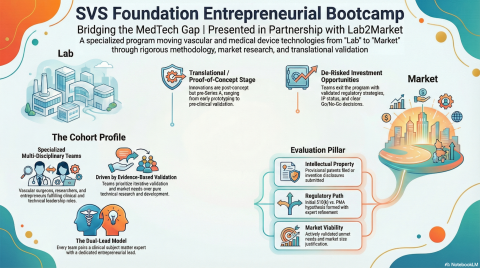
The SVS Foundation Entrepreneurial Bootcamp is intended for early- to mid-stage teams, led by a vascular surgeon, that have identified a clinical need, developed a potential solution, and are seeking to further define the commercial pathway.
Applicants/Teams
The primary applicant and team leader must be an SVS Active or Early Active Member. The team may include clinicians, researchers, engineers and entrepreneurs. Teams should demonstrate clinical and/or technical expertise, as well as an interest in advancing toward commercialization.
Stage of Innovation
Projects should at minimum be at the translational/proof-of-concept stage, typically:
Teams are expected to be actively evaluating:
Applications will be evaluated based on the following criteria:
Submissions Closed
The application is a 1–2-page narrative, excluding references, and should include the topics listed below. References may not exceed 1 additional (third) page.
Use Arial, 11pt font, 1” margins. Type density should conform with standard NIH guidelines (no more than 15 characters per inch, no more than six lines per inch).
Use section titles, images and graphics to assist reviewers in understanding your application.
Applications will be reviewed by the SVS Foundation and Lab2Market. Selected teams will be notified during the week of August 31, 2026, and invited to deliver a brief virtual presentation to a committee of subject matter experts during the week of September 28, 2026.
Selected teams will deliver a 10-minute virtual presentation to a committee of subject matter experts from SVS Foundation and Lab2Market. The presentation content should align with the information included in the submitted application. Additional guidelines will be shared in advance.
SVS Foundation will select the final teams to participate in the Entrepreneurial Bootcamp and notify accepted teams by October 31, 2026.
All intellectual property (IP) shall remain the sole property of the respective teams and/or their affiliated institutions. Teams are expected to be actively evaluating their intellectual property (IP) position. SVS, SVS Foundation, and Lab2Market have no ownership rights to any applicant's IP.
Lab2Market is an entrepreneurial training organization that helps biomedical innovators and early-stage companies evaluate commercial opportunities and accelerate the translation of new technologies to market. Since 2015, Lab2Market's leadership team and network of experienced C-level industry advisors have trained more than 200 biomedical innovation teams through programs supported by organizations including the National Institutes of Health (NIH) and the Department of Veterans Affairs (VA).
A distinguishing feature of the Lab2Market approach is its combination of structured entrepreneurial education, personalized business coaching, and project management support. Each team works closely with experienced advisors who help participants assess unmet clinical needs, validate market opportunities, evaluate commercialization strategies, and develop a clear path to market.
Through the SVS Foundation Entrepreneurial Bootcamp, Lab2Market will provide vascular surgeon innovators with the tools, mentorship, and business expertise needed to determine whether their innovations have a viable commercial pathway and the potential to improve patient care.
Please contact svsfoundation@vascularsociety.org.
Dr. Sunita D. Srivastava’s journey into vascular surgery was shaped by a passion for surgery and a deep commitment to patient care.
The future of vascular surgery depends on more than clinical excellence. It requires sustained investment in research, education, leadership development, and innovation across the specialty.
That’s exactly what the SVS Foundation Annual Fund makes possible.
Through the Annual Fund, member support becomes a powerful, flexible investment in the field—helping fund the programs, people and ideas that move vascular surgery forward. Our goal is to raise $250,000 this year to expand that impact and create even more opportunities across the specialty.
The Annual Fund is the primary way members can support the SVS Foundation through flexible charitable giving.
Unlike gifts designated for a single program, Annual Fund contributions allow the Foundation to direct resources where they are needed most—and where they can make the greatest impact.
We invite you to learn more about how your support is making a difference—and consider making your Annual Fund gift today.
Dr. Loay Kabbani’s journey into medicine began in Damascus, Syria, where he was deeply influenced by a family legacy in healthcare. With a grandfather who practiced as a general physician and a father who trained as a cardiac surgeon in the United States, Dr.
Rachael Nicholson never set out to become a surgeon—let alone a vascular one. In fact, her early ambitions had nothing to do with medicine at all. As a mechanical engineering student at the University of Illinois, she imagined a future designing cars, not caring for patients.